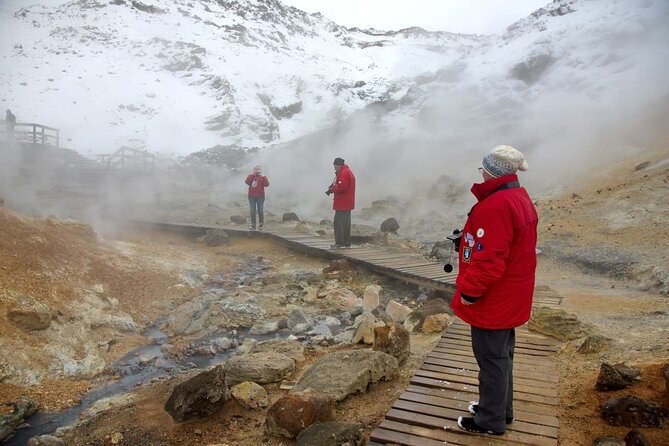
Private Reykjanes Peninsula Tour | Pick up from Keflavik International Airport
Airport pickupPrivateGuide
Starts at the runway fence, which is the point of fact number two. Four to five hours, one fare for the car.
From $1275 per group of up to 7
Keflavik asks departing passengers to arrive 2.5 to 3 hours before the flight. That is not a nervous traveller's rule of thumb, it is the airport's own published advice, and on a six-hour connection it is nearly half your gap. Every plan on the timing rules page works backwards from it.
The Reykjanes Peninsula, which is where the airport is, contains a footbridge between two continental plates, a field of boiling mud, Iceland's oldest lighthouse and a lava pool the sea fills and empties. All of it is within half an hour of the terminal. Most people drive straight past it to Reykjavik.
The city is a 45 to 50 minute drive on Route 41 — an hour and a half of your connection, return. On a six-hour gap that is the whole difference between a day out and a bus ride. The distances page has every stop as a drive time.
The Blue Lagoon is the single most-searched thing near the airport, and not one product on these pages covers admission to it. One route stops for a photograph, a coffee and the toilets, and its own itinerary says exactly that. If you want to bathe, book your own timed slot and treat the transfer separately.
It shut repeatedly from November 2023 to April 2024, lava destroyed its car park on 22 November 2024, and there were shorter closures again in 2025. The barriers held and the lagoon itself survived, but a layover built around it needs a second plan.
Some products here are priced per person and the rest per group, and the difference is enormous. A car at $1,275 for up to seven people is $182 a head; the same fare split between two is $637. Nothing else about the day changes that much with party size.
Around the solstice the sun comes up near 11:20 in Reykjavik and goes down near 15:30. A tour that starts at nine in the morning spends its first two hours in the dark, which is fine for an aurora chase and pointless for a waterfall. In late June the same city gets about twenty-one hours.
The aurora needs darkness, a clear sky and geomagnetic activity at the same moment. The four-hour aurora product here does not pretend otherwise: it runs only when conditions are favourable and is cancelled and refunded or postponed when they are not. That policy is the reason to book it on a connection rather than on your one free evening.
It is the Kerid crater, at 700 ISK, and the seven-hour Golden Circle tour has already paid it along with the car parks at Thingvellir and Faxi. Thingvellir, Geysir, Gullfoss and every Reykjanes stop are free to walk into.
The black sand beach below Vik has killed six people since 2007 and required at least twelve serious rescues, all from sneaker waves. The cave and the basalt columns now close during a red warning and the beach carries marked safety zones. It is still worth going; it is not worth turning your back on the water.
The Althing banned horse imports that year, and a horse that leaves Iceland may never return. What you sit on at a riding centre outside Reykjavik is about as close to a Viking-age horse as anything alive, and it has two gaits most breeds do not: the tolt and the flying pace, at which some reach 48 km/h.
Iceland is in the Schengen Area but not the European Union. Arriving from Copenhagen you walk straight out; arriving from Boston or London you queue at border control first, and at the peak of a morning bank that can be forty-five minutes. The connections page covers which direction produces which kind of gap.
PLAY ceased operations on 29 September 2025, so guidance written before that date and still talking about two Icelandic low-cost carriers is out of date. Keflavik handled 8,159,461 passengers in 2025 and remains Icelandair's hub, which is what produces the banked arrivals that make layovers here so common in the first place.
Most of the list above changes what you expect. Three of them change what you book, and they are worth putting side by side.
| The surprise | What it changes | What to do about it |
|---|---|---|
| Be back 2.5 to 3 hours before departure | Cuts a six-hour connection to about three hours out | Plan from the check-in time, not the gate time |
| Some fares cover the whole car | A party of six pays a quarter of what a pair pays a head | Work out the per-head figure first |
| December gives about four hours of light | A morning tour starts in the dark | Book an aurora departure, or travel in the light |
Everything else on the list is context. Those three are arithmetic, and the quick Reykjavik tour on an airport layover shortlist is built around them.
Three of them change a booking rather than a mood: the check-in advice, the price basis, and the daylight. Work those out first and the rest is detail. The planning page puts them in order, and the FAQs answer the ones this list does not.
Starts at the runway fence, which is the point of fact number two. Four to five hours, one fare for the car.
From $1275 per group of up to 7
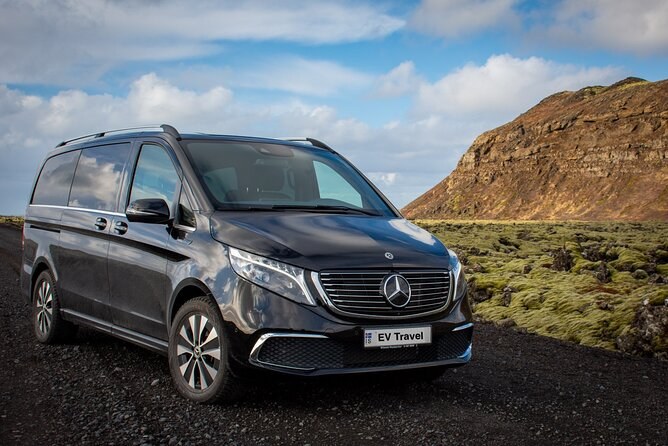
Six hours built round a flight, including the Blue Lagoon stop that is a look rather than a swim.
From $1424 per group of up to 5
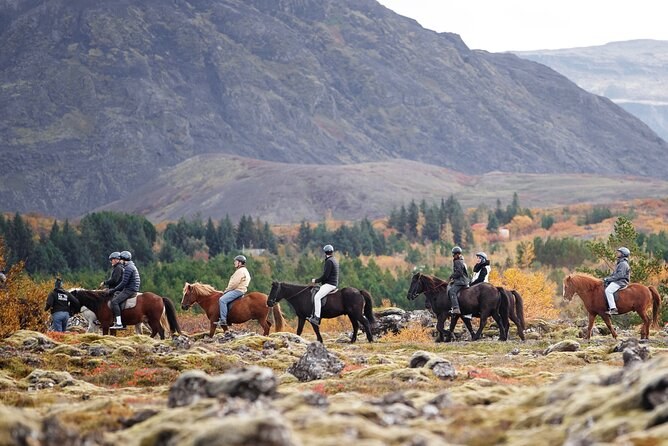
Two hours on a breed that has been closed to imports since 982, 35 minutes from the terminal.
From $156 per person
If any of that changed your plan, short Iceland layover routes and layovers of six hours or more both rebuild it. Iceland Layover Tours lists the departures.